Conference Rooms Are Leaking: Why Hybrid Meeting Infrastructure Has Become an Acoustic Security Liability
Photo: ООО «АЗИМУТ Хотелс Компани», CC BY-SA 4.0, via Wikimedia Commons
The Meeting Room Has Become a Microphone
For most enterprise security teams, the conference room represents a controlled environment — a space where access credentials are verified at the door and sensitive conversations are presumed to remain within four walls. That assumption has not kept pace with the technology now embedded in those rooms.
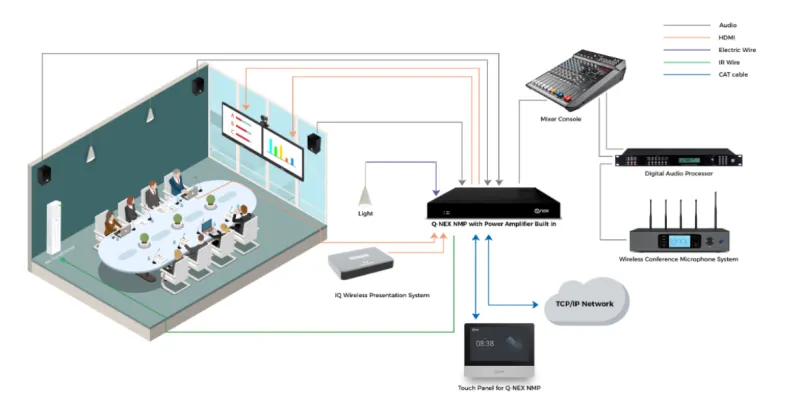
Modern hybrid meeting infrastructure — video conferencing endpoints, ceiling-mounted microphone arrays, AI-powered noise-cancellation systems, and cloud-connected collaboration platforms — has fundamentally altered the acoustic profile of enterprise workspaces. These systems are designed to capture, process, and transmit audio with remarkable fidelity. That fidelity, engineered for productivity, creates an equally precise instrument for acoustic intelligence gathering when security controls are insufficient or absent.
The risk is not theoretical. As voice authentication has expanded across enterprise access control frameworks — from call center verification to executive communication platforms — the acoustic environment surrounding those interactions has become operationally significant to adversaries. What an organization's meeting infrastructure hears, records, and transmits is now a legitimate concern for any CISO responsible for protecting authentication integrity.
What the Microphone Captures Beyond the Conversation
The most immediate acoustic threat in collaborative workspaces is voice sample harvesting. Video conferencing platforms record and, in many configurations, store meeting audio in cloud environments governed by third-party data retention policies. A threat actor who gains access to meeting recordings — through compromised credentials, insider access, or platform vulnerabilities — acquires a library of authenticated voice samples from identifiable individuals.
Those samples carry significant value. Modern voice synthesis tools can construct convincing vocal replicas from relatively short audio segments. A senior executive who participates in weekly all-hands calls, earnings briefings, or recorded client presentations is inadvertently contributing to a voice profile that, in adversarial hands, could be used to impersonate them across authentication checkpoints.
Beyond voice synthesis, the ambient acoustic data flowing through meeting infrastructure reveals information that extends well beyond spoken content. Keyboard acoustic patterns captured during screen-share sessions or live document collaboration can, under forensic analysis, yield keystroke inference data — a technique that has demonstrated the ability to reconstruct typed content with meaningful accuracy. Background conversations that bleed into active meeting audio can expose organizational context, project names, personnel decisions, and operational details that inform social engineering campaigns.
Noise-cancellation algorithms, paradoxically, can sharpen rather than obscure this risk. By isolating primary audio sources and suppressing competing signals, these systems produce cleaner recordings that are more amenable to downstream analysis — whether by legitimate platform AI or by an adversary processing captured audio.
The Hybrid Work Amplification Effect
The expansion of hybrid work across the US enterprise landscape has not simply increased the volume of meeting audio in circulation — it has distributed the acoustic attack surface across a far wider and less controllable set of environments.
When employees join enterprise meetings from home offices, shared coworking spaces, or public locations, the acoustic perimeter of the organization extends to every endpoint on the call. A participant connecting from a home network over a consumer-grade router, with a personal microphone and no endpoint security controls, introduces acoustic and network vulnerabilities that enterprise IT teams cannot directly govern.
This distribution creates compounding risk. A voice authentication system calibrated to verify identity based on acoustic signatures collected in a controlled office environment may behave unpredictably when those same voices are captured across a range of acoustic conditions — conditions that adversarial actors can study, model, and exploit. The inconsistency that hybrid environments introduce into voice biometric enrollment and verification processes is itself a vulnerability, creating edge cases that authentication systems may handle poorly.
Enterprise security architects who designed authentication frameworks before the normalization of hybrid work are increasingly operating with outdated assumptions about where organizational audio originates and what happens to it after capture.
Practical Protocols for Acoustic Security in Collaborative Environments
Addressing this exposure requires a structured approach that spans technology selection, policy governance, and user education. The following practices represent a baseline that enterprise security teams should evaluate against their current posture.
Audit meeting platform data retention policies. Every major video conferencing platform in enterprise use maintains its own data retention and processing terms. Security teams should conduct a formal review of where meeting recordings are stored, who has administrative access, how long recordings are retained by default, and under what conditions platform AI systems process audio content. Retention policies should be configured to the minimum operationally necessary duration.
Restrict recording permissions by role and context. Not all meetings carry equivalent sensitivity, but blanket recording permissions create unnecessary exposure. Enterprises should implement tiered recording governance that restricts automatic recording for sessions involving executive leadership, authentication-adjacent workflows, or discussions of security infrastructure. Role-based controls should govern who may initiate recordings and under what documented circumstances.
Evaluate voice biometric enrollment environments. Organizations deploying voice authentication should assess whether enrollment processes capture voice samples in environments that accurately represent operational conditions. Enrollment conducted exclusively in controlled office environments may produce authentication profiles that perform inconsistently against hybrid-captured audio, creating both false rejection rates and exploitable verification gaps.
Implement acoustic awareness training. End users are frequently unaware that their meeting participation generates acoustic data with security implications beyond the spoken agenda. A targeted training program should address the risks of joining sensitive meetings from acoustically compromised environments, the implications of background audio exposure, and organizational policies governing meeting recording and storage.
Incorporate acoustic threat scenarios into penetration testing. Red team exercises that do not account for acoustic attack vectors are leaving a meaningful surface unexamined. Enterprises should engage security teams capable of modeling voice sample harvesting, keystroke inference, and ambient audio analysis as components of a comprehensive assessment.
Closing the Gap Between Collaboration and Security
Hybrid meeting infrastructure is not going away. The productivity value it delivers is embedded in how US enterprises operate, and the platforms supporting it will continue to grow more capable — and more acoustically sophisticated — over time. The question for enterprise security leaders is not whether to restrict collaboration technology, but how to govern the acoustic data it generates with the same rigor applied to network traffic, endpoint activity, and identity credentials.
Authentication integrity depends on the assumption that the voice, pattern, or signal used to verify identity cannot be readily replicated by an unauthorized party. When meeting infrastructure routinely captures, stores, and transmits the acoustic raw material needed to undermine that assumption, that integrity is conditional at best.
Enterprises that treat the conference room — physical or virtual — as a neutral space rather than an active component of their acoustic security posture are carrying a liability that has not yet fully materialized in their risk registers. The time to account for it is before it appears in an incident report.