Immutable by Design, Vulnerable by Nature: Why Voiceprint Defense Demands a Completely New Security Paradigm
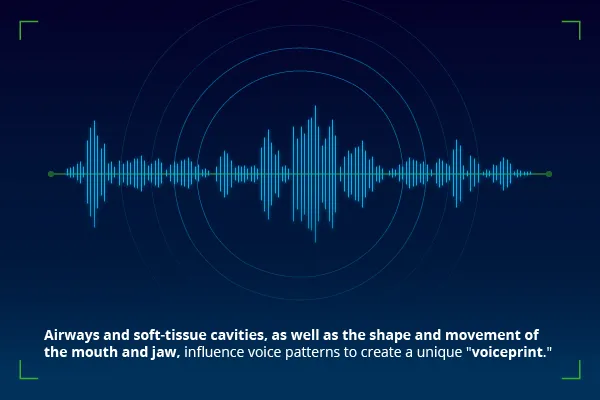
Photo: voice biometric security enterprise authentication waveform, via www.aware.com
The Fundamental Problem With Treating a Voiceprint Like a Password
When an enterprise password is compromised, the remediation path is straightforward: revoke the credential, issue a new one, enforce a rotation policy, and move on. The damage is real but contained. The underlying logic of password security is built on the assumption that credentials are replaceable — and that assumption has shaped nearly every authentication security framework developed over the past three decades.
Voiceprints do not work that way. A person's acoustic signature is a biological constant. It is derived from the geometry of their vocal tract, the resonance characteristics of their larynx, and dozens of other physical attributes that no IT administrator can modify with a policy change. When a voiceprint is compromised — when an attacker acquires a sufficiently detailed acoustic model of a target — the exposure is not temporary. It is permanent.
This is the foundational problem that security teams across the United States are only beginning to fully reckon with. The enterprise investment in acoustic biometrics has accelerated sharply over the past several years, driven by the genuine advantages these systems offer: frictionless authentication, strong liveness detection, and a credential that users cannot forget or share carelessly. But the security architectures surrounding those systems have, in many cases, been borrowed wholesale from password-era thinking — and that borrowing is creating dangerous structural gaps.
Why Public Exposure Is a Permanent Attack Surface
Consider how easily an attacker can acquire raw acoustic data on a high-value target. Corporate executives routinely appear in earnings calls, investor presentations, conference keynotes, and media interviews — all of which are recorded, archived, and publicly accessible. Senior government officials, legal professionals, healthcare administrators, and financial advisors similarly generate substantial public voice records in the course of ordinary professional activity.
Sophisticated threat actors do not need to intercept a live call or plant a recording device. They can construct a detailed acoustic model of a target using entirely open-source material. And because the underlying physical characteristics that model captures are immutable, no amount of credential hygiene on the target's part can invalidate it.
This stands in stark contrast to the threat model that governs password security. A stolen password has a finite useful life — it can be changed, it can expire, and it can be rendered worthless through multi-factor enforcement. A stolen voiceprint, particularly one refined through modern neural synthesis techniques, does not expire. The attack surface it creates persists for the lifetime of the target.
Organizations that understand this distinction intellectually but have not yet translated it into architectural changes are, in effect, operating voiceprint authentication systems with a permanent, unrevocable master key floating in the public domain.
Where Password-Era Thinking Fails Most Visibly
The security logic borrowed from password management tends to manifest in voiceprint systems in a few specific and problematic ways.
First, there is an over-reliance on enrollment quality as a proxy for security. Password systems focus heavily on creation rules — length, complexity, uniqueness. The equivalent instinct in voiceprint deployments is to invest in high-quality enrollment recordings and precise acoustic modeling. That investment is not wasted, but it addresses the wrong threat. The quality of the enrolled voiceprint does nothing to protect against an attacker who has independently constructed an equally detailed model from external sources.
Second, many deployments treat voiceprint authentication as a terminal verification step rather than a continuously evaluated signal. Password systems are binary by design — you either know the credential or you do not. Applying that same binary logic to acoustic authentication ignores one of the medium's most powerful defensive properties: the ability to evaluate not just whether a voice matches a stored template, but whether the behavioral and contextual characteristics of that voice are consistent with the authenticated user across an entire interaction.
Third, incident response protocols built for credential compromise often do not translate meaningfully to voiceprint breaches. There is no acoustic equivalent of a forced password reset. Security teams that have not developed voiceprint-specific response procedures will find themselves improvising under pressure — which is rarely when organizations make their best security decisions.
Behavioral Acoustic Markers: The Defense That Passwords Could Never Offer
The same immutability that makes voiceprints a persistent attack surface also creates a defensive opportunity that password systems cannot replicate. Human speech is not simply a static acoustic template — it is a rich, dynamic behavioral signal that encodes far more information than the baseline characteristics used for identity verification.
Emerging approaches to voiceprint defense are moving beyond static template matching and toward continuous behavioral acoustic analysis. This means evaluating not just whether a voice sounds like the enrolled user, but whether the micro-patterns of that voice — the subtle rhythms of speech, the characteristic hesitation markers, the stress patterns under different conversational conditions — are consistent with the behavioral baseline established over time.
Synthetic voice systems, even highly sophisticated ones, tend to reproduce the acoustic signature with reasonable fidelity while struggling to replicate the full behavioral envelope. A deepfake voice may pass a static template match while exhibiting measurable deviations in prosodic rhythm, response latency, or spectral consistency across extended interaction. Continuous behavioral analysis creates a detection surface that pure template matching does not.
Additionally, contextual acoustic intelligence — evaluating the environmental signature of an authentication attempt, the device characteristics of the audio channel, and the behavioral consistency of the session as a whole — can provide meaningful anomaly detection that compensates for the irreversibility of voiceprint exposure.
Architectural Implications for Enterprise Security Teams
For CISOs and enterprise security architects, the practical implication is that voiceprint authentication systems require a defense strategy designed around the specific threat model of acoustic biometrics — not a repurposed version of credential security logic.
That means building liveness detection and behavioral consistency analysis into the authentication pipeline as primary controls, not secondary validation layers. It means establishing acoustic threat intelligence programs that monitor for the emergence of synthetic voice models targeting key personnel. It means developing incident response protocols that acknowledge the permanence of voiceprint exposure and define compensating controls that can be activated when a compromise is suspected.
Perhaps most importantly, it means reconsidering the role of voiceprint authentication within a broader multi-modal framework. A voiceprint that cannot be changed should not, by itself, serve as the sole gating credential for high-stakes access decisions. Layering acoustic authentication with behavioral, contextual, and environmental signals creates a composite credential that is substantially harder to replicate — even when the static acoustic template has been compromised.
Conclusion
The enterprise adoption of acoustic biometrics represents a genuine security advance over legacy credential systems. But that advance comes with a threat model that is categorically different from the one that shaped how organizations think about authentication security. Voiceprints are not passwords with better entropy — they are permanent biological artifacts that require a defense architecture built specifically for their unique properties.
Organizations that recognize this distinction and invest accordingly will find that acoustic authentication's immutability, properly defended, becomes a strategic strength. Those that do not will eventually discover that the credential they cannot change is also the vulnerability they cannot close.